Believe it or not, Hollywood may be headed for another work stoppage in just two weeks. In 2007-2008, the Writers Guild struck, shuttering television and film production. In 2008-2009, a Screen Actors Guild stalemate lingered for almost a year, shutting down primarily film production. This time, the Hollywood Teamsters may strike - and that could immediately halt television and film production. For details, see my exclusive Hollywood Reporter story.
Sunday, July 18, 2010

Wednesday, June 30, 2010
Musicians Play a New (Media) Tune
In the “While you were out” department, the American Federation of Musicians and the studios signed a new deal . . . four months ago. But don’t feel like we’re late to the party — the deal doesn’t seem to have been reported in the Hollywood press. Talk about sotto voce. The negotiations themselves concluded in early November of last year, as I reported at the time, but it apparently took a while to reduce the deal to writing.
There are several items of note (so to speak) in the signed agreement, which runs through February 23, 2013:
* Wage increases are small by most Hollywood union standards: 1.5% or 2% per year. However, the increases in the AFM’s previous signed agreement also weren’t large by those standards, where 3.0%-3.5% have been the recent norm. Thus, it’s unclear if these numbers signify anything about the size of increases that the above the line unions will achieve in the upcoming (October 1 and beyond) cycle of bargaining.
* The Health Plan is being juggled around a bit. One thing that stands out apparently mirrors a provision in the IATSE health plan deal: up to 1% of the wage increases can be converted instead to an increased contribution to the health plan, if necessary for the plan’s financial reserves. That’s intriguing, because what usually happens in the above the line guilds and unions is that at most 0.5% of a wage increase goes instead to an increased P&H contribution. Depending on the needs of the above the line health plans (each union or guild has its own), we might see a 1% conversion in the upcoming negotiations.
* The New Media template adopted by the above the line unions and guilds and by IATSE has now been adopted by the Musicians as well. The AFM deal resembles the IA’s, in that there are somewhat fewer residuals than the above the line unions and guilds achieved. For instance, when a television show is streamed on ad-supported new media (such as the free version of Hulu), the above the line unions and guilds receive residuals but IATSE and AFM don’t.
Tuesday, June 22, 2010
Silly Lawsuit Against SAG Dismissed; and More
Remember the lawsuit that former SAG president Alan Rosenberg and three other Membership First members (1st VP Anne-Marie Johnson and board members Diane Ladd and Kent McCord) filed against their own union?
No? You may have blissfully forgotten this misbegotten legal action, filed a year and a half ago (!), but the courts haven’t. This is the lawsuit that attempted to reinstate former SAG National Executive Director Doug Allen and undo ratification of the SAG-AMPTP collective bargaining agreement. In a case of chasing a horse that’s left the barn, and despite two court decisions that the action was moot, the lawsuit drags on.
Or maybe not. This morning, yet another judge declared the lawsuit moot. That’s five judges total, since one of the previous decisions was by a three judge panel. In a statement, SAG’s Deputy National Executive Director and General Counsel, Duncan Crabtree-Ireland, said “Screen Actors Guild is gratified that this litigation has now concluded with a final reaffirmation of the Guild's position by the trial court.”
Let’s hope. Interestingly, in their opposition filing, the plaintiffs did not oppose dismissal of their complaint. But an observer pointed out that the plaintiffs have crafted their document, and their statements in the courtroom, so as to tee up a motion for attorneys fees. In other words, Rosenberg et al. will probably ask the court to order that SAG pay Rosenberg et al.'s attorneys fee for bringing a case that five judges declared moot and that at the end of the day Rosenberg's own attorneys were willing to dismiss!
——
In other guild and union news of late:
· In a surprising move, SAG’s Unite for Strength faction reached across the aisle and chose Membership First hardline David Joliffe as the chair of the Negotiating Committee for the AMPTP talks that begin October 1, reports SAGWatch.
· Those talks involve both SAG and AFTRA, negotiating together once again after a bitter hiatus in the last negotiating cycle. In order to make the schedule for joint negotiations work, AFTRA leadership has agreed to a one-year extension to its so-called “front of book” – the portion of its agreement with the AMPTP that covers daytime serials (soap operas) and various other work whose jurisdiction is not shared with SAG.
The extension, which runs through Nov. 15, 2011, is noteworthy for two reasons. First, the compensation increase, effective Jan. 1, 2011, is 2.5% (2% increase in minimums and 0.5% increase in pension and health contributions), significantly less than the 3.5% that was agreed to in the last negotiating cycle, which began before the economy had spiraled into recession. That 2.5% may well set a precedent for the October 1 negotiations.
Second, the extension does not change the new media provisions in any way. This suggests that any changes will be handled in the October 1 negotiations. Those issues will probably be hard fought.
The extension goes out for a vote in a few weeks to membership meetings in the five major AFTRA Locals of Chicago, Los Angeles, New York, San Francisco and Washington/Baltimore.
· Speaking of front of book, a new version is now available from AFTRA, incorporating the changes agreed to in 2008. Yes, these books take a while to revise, and, alas, the AFTRA book still uses the same almost unreadable tiny typeface as previous editions. None of the other guild/union books do, and the WGA has even moved away from the small format books to a large size that’s more manageable.
A noteworthy change in the AFTRA book: Ex. A (the portion that is jointly negotiated with SAG) is no longer included. Word is that there will be a separate Ex. A book eventually, but no information on when. That book, if and when it appears, will presumably incorporate the results of the Oct. 1 negotiations.
· It turns out even unions sometimes have unions. SAG does – in particular, a few dozen of its employees are represented by Teamsters Local 986. The contract between SAG and 986 expired June 1, and negotiations are ongoing. In a statement, SAG declined to provide any details on progress: “Screen Actors Guild and Teamsters Local 986 continue to negotiate for a successor agreement. Having agreed to bargain across the table and not in the media, SAG will have no further comment at this time.”
· The Writers Guild voted a few days ago to revise its credit rules. Variety has details on this relatively technical change. And speaking of WGA credits, why not have end credits for “Additional writing by,” so that all participating writers get credit? Decades ago, the WGA agreement provided for a credit of this sort, but it was eliminated in order to create the often-fictional idea that only a small number of writers contribute to a script. The result: caterers get credit and many writers don’t.
· In other WGA news, the WGA West announced 18 candidates running for 8 open board seats: Robin Schiff, David Shore, David A. Goodman (inc.), Cheryl Heuton, Aaron Mendelsohn (inc.), Katherine Fugate (inc.), Timothy J. Lea, Mick Betancourt, Mark Gunn (inc.), Erich Hoeber, Erica Montolfo, Matt Pyken, Naomi Foner, Karen Harris (inc.), Kathy Kiernan (inc.), Christopher Keyser, Steve Skrovan, Matthew Weiner. (inc. means incumbent, and the order of the list was determined by lot). There will be a candidates night Sept. 7 in LA. Voting is by mail or at the WGA annual meeting Sept. 16, with ballots counted the next day.
· This summer is also SAG election season. The president is not up, but 1/3 of the board is. Candidates are usually announced in late July, with voting closing in late September. No details as yet.
· The WGA East (which has a snazzy new logo) announced 23 new digital media signatories to new contracts, bringing the total number of WGAE digital signatories to 43. Twenty eight writers have become new Guild members as a result of the new contracts.
· Finally, an item from a couple months back: AFTRA and the AFM, which represent recording artists and musicians respectively, sent a letter to the Teamsters supporting efforts by composers and lyricists to unionize. The Teamsters are assisting the efforts of the music scribes, who are among the few non-unionized workers in the business (with computer effects workers being another large group). No word on any progress though.
———————
Subscribe to my blog (jhandel.com) for more about entertainment law and digital media law. Check out my residuals chart there too. Go to the blog itself to subscribe via RSS or email. Or, follow me on Twitter, friend me on Facebook, or subscribe to my Forbes.com or Huffington Post articles. If you work in tech, check out my book How to Write LOIs and Term Sheets.
Wednesday, April 28, 2010
JLH on Forbes.com
Just a note (or point of personal privilege, as I guess some SAG board members are wont to say): my blogging now appears on Forbes.com's The Biz Blog. Check it out - or keep reading me here, since everything I write for Forbes.com will also be posted here. My posts will also continue to appear on the Huffington Post, IMDb, AlwaysOn and my Twitter and Facebook.
DGA to Negotiate on SAG & AFTRA's Heels
The Directors Guild announced on its website today that it will begin negotiations with the AMPTP (studio alliance) in mid-November, which is immediately after the scheduled end of 45 days of negotiation between the AMPTP and SAG (Screen Actors Guild) & AFTRA (a smaller performers union).
The DGA contract (like those of SAG, AFTRA and the WGA) expires in mid-2011, but the DGA always negotiates early. Still, the announcement puts enormous pressure on SAG and AFTRA to conclude an agreement in October or early November of this year. If they don’t, the DGA will step in and do a deal first, setting a template that SAG and AFTRA may not like. Indeed, the announcement also says that the DGA will engage in informal discussions with the AMPTP before mid-November, which will prepare the DGA to do a deal promptly before the holiday season sucks the wind out of the town.
The prospect of the DGA stepping in, and the fact that it will negotiate informally even before then, could reduce SAG and AFTRA’s leverage, though at least one industry observer familiar with the situation said that SAG does not consider the DGA scheduling a cause for concern. Still, the DGA timing may reduce the likelihood of significant change in the new media provisions of the contracts, unless the DGA is pushing for the same changes as well. Hopefully, SAG, AFTRA and the DGA will coordinate their proposals. The timing of the DGA negotiations increases the likelihood that they will.
SAG, AFTRA and the AMPTP declined to comment.
The DGA announcement is below.
———————
Subscribe to my blog (jhandel.com) for more about entertainment law and digital media law. Check out my residuals chart there too. Go to the blog itself to subscribe via RSS or email. Or, follow me on Twitter, friend me on Facebook, or subscribe to my Forbes.com or Huffington Post articles. If you work in tech, check out my book How to Write LOIs and Term Sheets.
———————
Negotiations Announcement from DGA President Taylor Hackford and Negotiations Chair Gil Cates (April 28, 2010)
"We have reached an understanding with the AMPTP to begin formal negotiations for a new agreement in mid-November of this year, after the scheduled AFTRA-SAG negotiations begin on October 1.
"As is our custom, we will engage with the AMPTP to clarify and narrow the issues before the beginning of formal negotiations. We will use these discussions to confirm that both parties are committed to negotiating a fair agreement that will protect the economic and creative rights of DGA members while accomplishing the important objective of keeping our industry working in this challenging period.
"Following our traditional practice, the DGA began serious preparations for these negotiations well in advance of our contract expiration. In January, the National Board appointed Gil Cates as Negotiations Chair. Our consultants and research department have begun updating our business and revenue forecasts and assimilating the data collected in the last few years. Our councils, committees and staff have also begun their work to identify issues and prepare proposals.
"Our full Negotiating Committee will be appointed in June and will begin meeting this summer to prepare the DGA proposals.
“We wholeheartedly support SAG's and AFTRA's decision to move forward with joint negotiations and wish them every success when they begin their own negotiations with the AMPTP in October."
Monday, April 19, 2010
Century City Bar Entertainment Symposium
All dressed up and nowhere to go after work? If you happen to be an entertainment lawyer in and around
Up first: tomorrow night (Tuesday, April 20) features a look at pitfalls and issues during the development process. The following sessions (April 22, 26 & 28) look at financing, production and distribution. Each night is a convenient 6:30-8:00, followed by a cocktail reception, allowing time to network with the panelists (attorneys from private practice and studios). Full disclosure: my colleague Louis Dienes is president of the CCBA.
Saturday, April 10, 2010
Survey in Progress re WGA Strike
Nina O'Brien, a doctoral student at USC's Annenberg School who focuses on entertainment labor issues, is doing an anonymous study of the WGA strike and would like your participation if you're in or affiliated with the TV or film industry. Please help her out by taking her survey at http://survey.qualtrics.com/SE/?SID=SV_8uWs20JwWJp6uB6&SVID=Prod. Thanks!
———————
Subscribe to my blog (jhandel.com) for more about entertainment law and digital media law. Check out my residuals chart there too. Go to the blog itself to subscribe via RSS or email. Or, follow me on Twitter, friend me on Facebook, or subscribe to my Huffington Post articles. If you work in tech, check out my book How to Write LOIs and Term Sheets.
Wednesday, April 7, 2010
A “New” Entertainment Union - And a Possible Name
AFTRA is interested in merger with the Screen Actors Guild, but not if the effort is going to fail again. So we learn from an article appearing in the just-mailed Spring 2010 issue of AFTRA Magazine. The union makes clear that any such effort will encompass all of its members, and emphasizes that the goal is “creating one media and entertainment union for all actors, performers and broadcast journalists.”
SAG reacted favorably, with guild president Ken Howard remarking in an email to me, “I’m delighted to see AFTRA’s leadership speak out forcefully about something that I and other SAG leaders so strongly support. Joining SAG and AFTRA to create a single union is essential to performers’ maximizing their power. It’s undoubtedly an idea whose time has come.”
(AFTRA, for the non-laborites among my readers, is the American Federation of Television and Radio Artists. The Screen Actors Guild (SAG) and AFTRA share jurisdiction over scripted television programming.)
So far, nothing unexpected. But what is new is the letter’s proposal that the new union have “a structure where no single city or no single category of member—actor, recording artist or broadcaster—is able to unilaterally impose its will on everyone else.” That description could just as well apply to AFTRA’s own current structure. SAG’s governance is quite different, and a simple majority of the
Adopting a more AFTRA-like structure is bound to sit poorly with SAG’s Hollywood-based Membership First Faction. That’s the same stale group that has previously disparaged AFTRA and that caused the year-long contract impasse that cost SAG dearly. However, even non-MF
Meanwhile, also new is the article’s conceptualization of the effort not as merger, but as the creation of “A New Union for a
The article stresses that power should be the main goal, with other factors – elimination of duplicative dues, easing the ability to qualify for pension and health plans, and reduction of redundant administrative costs – treated as secondary. I wouldn’t downplay those secondary advantages quite as much as the article does, but the point is clear.
What’s less obvious from the piece is how creation of a new, merged union would increase union leverage. The article, styled as an open letter from AFTRA elected leadership (Roberta Reardon, Bob Edwards, Ron Morgan, Matthew Kimbrough and Lainie Cooke), notes that on the management side, many of the same companies are the employers of actors, other performers and broadcast journalists. (This is less true of another category of AFTRA member, musicians, since only one of the big four labels, Sony Music, is owned by an audiovisual company.)
However, this is less significant than it seems. The fly in the ointment is that since these different categories are employed under different contracts, each with no-strike clauses, joint strikes would be impossible. Does that mean that the letter is no better than a misaddressed email?
Not necessarily. On the contrary, I think the article is on to something if the goal is to create a larger community of interest among the different categories of member. It will, however, take assertive cross education and meetings between different type of workers – in other words, cross-category community building – in order for this to play out. Even if cross-category strikes are impossible, solidarity picketing and informal pressure may not be – just as we saw when SAG supported the Writers Guild during the latter’s strike. That support ultimately was one key to ending the 100 day labor dispute.
Cross education won’t be easy. The article pictures a commonality of interest, citing “salary reductions and added work responsibilities facing broadcasters, declining quotes and reduced work opportunities for actors or record labels’ imposition of ‘360 deals’ on recording artists” as though they were one and the same thing. However, it takes a bit of digging to identify technology as the common factor, since its manifestations are somewhat different – and, thus, so are the implications for labor.
Is technology a strong enough thread out of which to weave a community of interest? After all, technological change affects nurses, autoworkers and lawyers too, yet that doesn’t mean that these groups have enough commonality to foster solidarity between them. Do media workers? Maybe so, but it will take more fleshed out examples to make the point., and hard work to accomplish the goal
Nonetheless, SAG-AFTRA merger is a smart move for media workers. It is, at the least, a step in the direction of creating a larger community of interest and it addresses the dues, pension and health plans, and administrative costs issues. Moreover, it would make it harder for management to play SAG and AFTRA off against each other in negotiations.
The article alludes briefly to “secondary micro-issues” that helped scuttle merger the last two times it was attempted. In my view, those issues deserve a fuller airing well in advance of a merger attempt. The key issues are merger or revision of the health plans, merger of the pension plans, and the name of the new union.
Merger or revision of the health plans seems doable. After all, companies change health plans with some frequency; why can’t two unions, or a new union, change health plans and converge to the same plan? Merger of the pension plans is a more technical issue, and there probably needs to be an au current study done.
The third issue is the one that makes for a nice political football: should the new union be called SAG, AFTRA, AIMA (a proposal during the last merger attempt), or something different? MF partisans have a clear opinion: “You’ll pry my SAG card from my cold, dead hands” seems to be the thinking. Indeed, some probably intend to be buried with their cards.
Extreme or not, there is a reality here: a SAG card is aspirational, whereas an AFTRA card is not. The buff young trainers at my gym sidle up to me and in a whisper beg to learn how they can get their SAG cards. Do I have any in’s with the staff? Is there something I can do? If only the answer were yes, I’d probably have dates every Saturday into eternity. An AFTRA card, in contrast, might be enough for a free workout on a slow day.
Why the difference? Three reasons, probably:
First, as SAG partisans point out, “SAG” is a brand name with greater name recognition, or brand equity, as trademark experts like to say. With due respect to my AFTRA friends, the SAG partisans are right: clearly, more of the general public has heard of SAG than of AFTRA.
Second, “SAG” symbolizes the glamour of the movies; AFTRA symbolizes the technology of TV. Would you rather be 20 feet tall on a movie screen or 20 inches tall on a TV screen? Leave aside the reality that most people watch most movies on home video anyway, movies still have a cachet that television doesn’t.
Third, anyone can get an AFTRA card if they pay the initiation fee. In contrast, SAG is an exclusive club, albeit one with 126,000 members, two-thirds or more of whom don’t work as performers in any given year. Here again, the reality isn’t nearly as seductive as the perception, but so it goes.
So are we stuck in a world where SAG has to discard its name, which I think it will never do, or AFTRA has to accept “SAG” as the name of a merged union, which is also unlikely? No. The solution is easy, and it’s the same approach that was chosen when two rival union federations, the American Federation of Labor (AF of L) and the Congress of International Organizations (CIO) merged in 1955. The name of the merged organization? The American Federation of Labor and Congress of International Organizations – unwieldy, but no one calls it that. They call it the AFL-CIO. Short and simple.
And so would be the obvious equivalent for SAG and AFTRA: “SAG-AFTRA.” It’s short, easy to pronounce – easier than AFTRA-SAG – and it puts the union with the larger membership and more name recognition first. It’s a name that may be the best hope for a merger – or creation of a new union, call it whichever you prefer.
Will a new name require mental adjustment? Of course. No doubt the transformation of the Screen Writers Guild and Television Writers Guild into the Writers Guild of America required adjustment too. Ditto the mergers and name changes that led to the Directors Guild.
But SAG hardliners, ask yourself this: would you rather adjust to a new name, or do you prefer to deny health care to yourself and your family when you split work between the two unions and fail to meet either one’s threshold for coverage? Do you like paying two sets of dues and watching management play ping pong with two unions?
Sunset Boulevard got it wrong: the pictures – and the salaries – are getting smaller. It’s the companies that got bigger. Maybe it’s finally time for the unions to get bigger too.
———————
Subscribe to my blog (jhandel.com) for more about entertainment law and digital media law. Check out my residuals chart there too. Go to the blog itself to subscribe via RSS or email. Or, follow me on Twitter, friend me on Facebook, or subscribe to my Huffington Post articles. If you work in tech, check out my book How to Write LOIs and Term Sheets.
Thursday, March 25, 2010
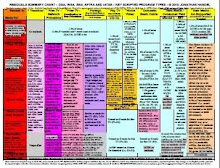
Residuals Chart Available
Residuals are complex. Flummoxed by formulas? Most people are. Whether it’s 1.2% of gross, 100% of TAM, or the complexities of new media, it’s easy to find your knickers in a twist if you spend more than a few minutes puzzling over this stuff.
Puzzle no longer — or, at least, not as much as before. I’ve managed to compress most of the guild and union residuals formulas onto a single page color chart. A second page gives cross references to the actual sections and paragraphs of the guild and union agreements themselves. That means you can look up the actual contract language and marvel at its opacity.
The chart’s not available in stores, but it is free, and suitable for framing. You could also laminate it for a nice placemat. Get your copy here: http://jhandel.com/residuals (check back from time to time for updates). Feel free to print, email and distribute. And let me know if you have corrections or comments.
———————
Subscribe to my blog (jhandel.com) for more about entertainment law and digital media law. Go to the blog itself to subscribe via RSS or email. Or, follow me on Twitter, friend me on Facebook, or subscribe to my Huffington Post articles. If you work in tech, check out my book How to Write LOIs and Term Sheets.
Saturday, March 13, 2010
SAG Approves Joint Bargaining with AFTRA
The Screen Actors Guild national board this morning approved an agreement to hold joint negotiations with AFTRA with the studio alliance (AMPTP) later this year, for 45 days starting on October 1. That was the date for SAG and the AMPTP to begin early negotiations. Now it will be SAG and AFTRA jointly meeting with the AMPTP. The vote was expected, and was by a strong margin: 78% to 22%, according to a SAG spokeswoman.
This is good news for the industry, and dramatically reduces the possibility of further labor disturbance in the upcoming negotiating cycle. AFTRA’s national board approved joint bargaining three weeks ago, on February 27, so all that remains is presumably finalizing the text of the joint bargaining agreement and then signing on the dotted line.
AFTRA and the AMPTP had no comment.
A Membership First crowd of demonstrators outside the SAG meeting was minimal – about 20 to 25 people by reports from non-MF sources. Emails to MF were not immediately returned.
Subscribe to:
Posts (Atom)